


Hey there! As a supplier of Hybrid Power Catamarans, I often get asked about various technical aspects of these amazing vessels. One question that pops up quite frequently is, "What is the turning radius of a Hybrid Power Catamaran?" Well, let's dive right into it and explore this topic in detail.
First off, let's understand what a Hybrid Power Catamaran is. These boats combine traditional fuel - powered engines with electric propulsion systems, offering the best of both worlds in terms of performance and environmental friendliness. You can learn more about them on our website, Hybrid Power Catamaran.
Now, the turning radius of a boat is the radius of the circle that the boat makes when it executes a full - 360 - degree turn. It's a crucial factor, especially when you're navigating in tight spaces like marinas or narrow waterways. A smaller turning radius means better maneuverability, allowing you to make sharp turns with ease.
The turning radius of a Hybrid Power Catamaran can vary depending on several factors. One of the most significant factors is the size of the catamaran. Generally speaking, larger catamarans tend to have a larger turning radius compared to smaller ones. This is because the longer the hulls and the wider the beam (the width of the boat at its widest point), the more space the boat needs to complete a turn.
For example, a small - sized Hybrid Power Catamaran, say around 20 - 30 feet in length, might have a turning radius of around 20 - 30 feet. These smaller boats are highly maneuverable and can easily navigate through congested areas. On the other hand, a large - scale Hybrid Power Catamaran, perhaps 60 feet or more in length, could have a turning radius of 50 - 100 feet or even more.
Another factor that affects the turning radius is the type of propulsion system. In a Hybrid Power Catamaran, we have both the fuel - powered engines and the electric motors. The way these two systems work together can impact the turning ability.

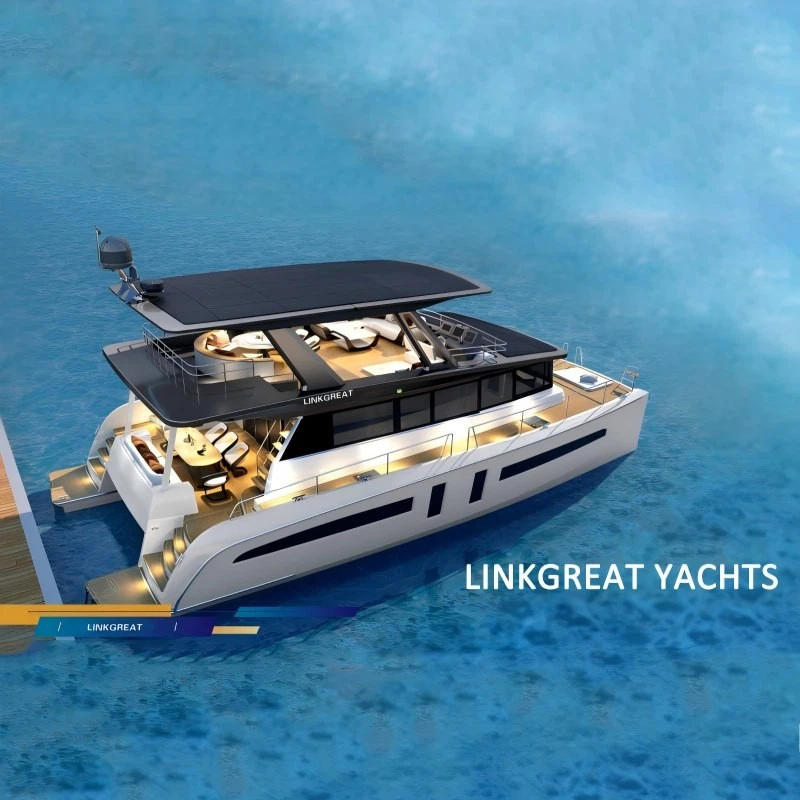
When using the fuel - powered engines, the turning radius can be influenced by the engine power, the number of engines, and the propeller design. High - powered engines can provide more thrust, which can help in making quicker turns. Multiple engines also offer better control, as you can adjust the power output of each engine independently. For instance, if you have two engines on a catamaran, you can increase the power on one side and decrease it on the other to make a sharp turn.
The electric motors in a Hybrid Power Catamaran also play a vital role in turning. Electric motors offer instant torque, which means they can quickly change the speed and direction of the propellers. This can be particularly useful when making precise turns at low speeds, such as when docking. In some cases, the electric motors can be used in combination with the fuel - powered engines to optimize the turning performance.
The hull design of the catamaran is yet another important factor. Catamarans have two parallel hulls, and the shape and spacing of these hulls can affect the turning radius. A catamaran with a wider beam and well - designed hulls can have better stability and turning ability. Some modern catamarans are designed with a special hull shape that reduces drag and improves maneuverability.
The weight distribution on the catamaran also matters. If the weight is unevenly distributed, it can affect the balance of the boat and make it more difficult to turn. For example, if all the heavy equipment is placed at the back of the boat, it can cause the front to lift, reducing the steering effectiveness. So, proper weight distribution is essential for maintaining a good turning radius.
Now, let's talk about how we, as a Hybrid Power Catamaran supplier, ensure that our boats have an optimal turning radius. We work closely with naval architects and engineers to design catamarans with the best possible hull shapes, propulsion systems, and weight distribution. Our Hybrid Propulsion Catamaran models are carefully engineered to offer excellent maneuverability.
We conduct extensive testing on our catamarans to measure the turning radius and make any necessary adjustments. During these tests, we simulate different operating conditions, such as high - speed turns, low - speed turns, and turns in various water conditions. This allows us to fine - tune the design and ensure that our catamarans meet the highest standards of performance.
In addition to the technical aspects, the skill of the boat operator also plays a role in the turning radius. An experienced captain knows how to use the propulsion systems effectively, how to read the water conditions, and how to anticipate the boat's movement. We provide training and support to our customers to help them get the most out of their Hybrid Power Catamarans.
If you're in the market for a Hybrid Power Catamaran, it's important to consider the turning radius based on your specific needs. If you plan to use the boat in crowded marinas or narrow waterways, a catamaran with a smaller turning radius would be more suitable. On the other hand, if you're going to be cruising in open waters, a larger turning radius might not be as much of an issue.
In conclusion, the turning radius of a Hybrid Power Catamaran is influenced by multiple factors, including the size of the boat, the propulsion system, the hull design, the weight distribution, and the operator's skill. As a supplier, we take all these factors into account to design and build catamarans that offer excellent turning performance.
If you're interested in learning more about our Hybrid Power Catamarans or have any questions about the turning radius or other technical aspects, we'd love to hear from you. Reach out to us to start a conversation about your boating needs and how our catamarans can meet them. We're here to help you find the perfect Hybrid Power Catamaran for your adventures on the water.
References
- Naval Architecture textbooks
- Industry research on Hybrid Power Catamarans
- In - house testing reports on catamaran turning performance


